Visualizing Moon Fragments from Seveneves
I recently started listening to an audiobook for Seveneves by Neal Stephenson, and the story wastes no time in raising the stakes. On the first page of the book, we witness the event that sets everything in motion. The moon explodes. As humanity comes to terms with the new state of the moon, seven fragments in the night sky, something unexpected happens. Two pieces collide, forming eight pieces. Shortly after that, "Doc" Dubois Harris, an astronomer, gives the US president an update on what this means. Fragments of the moon will continue to collide with each other, making more and more fragments until they start to pellet the Earth in what they term “Hard Rain”. As I heard this description, I couldn’t help but think it would be cool to see VFX for this or maybe a simulation, like if I were a presentation, you had to show an example to the president without much time to prepare.
In that vein, I asked Preplexity AI to help create a visualization of this idea, so it’s easier to grasp what is happening to the moon's fragments and how insane it would be as they begin to collide exponentially.
After the first visualization, I was curious how big an impact would need to be to break up the moon as described in the book? The short answer is very large. But I thought it would be more fun to have something interactive to see how much energy you would actually need to make something so catastrophic.
Last but not least in the trip down breaking apart the moon. Is a chart comparing energy levels to help understand just how massive such an impact would be. Even some the largest impacts known to humanity aren’t even close.
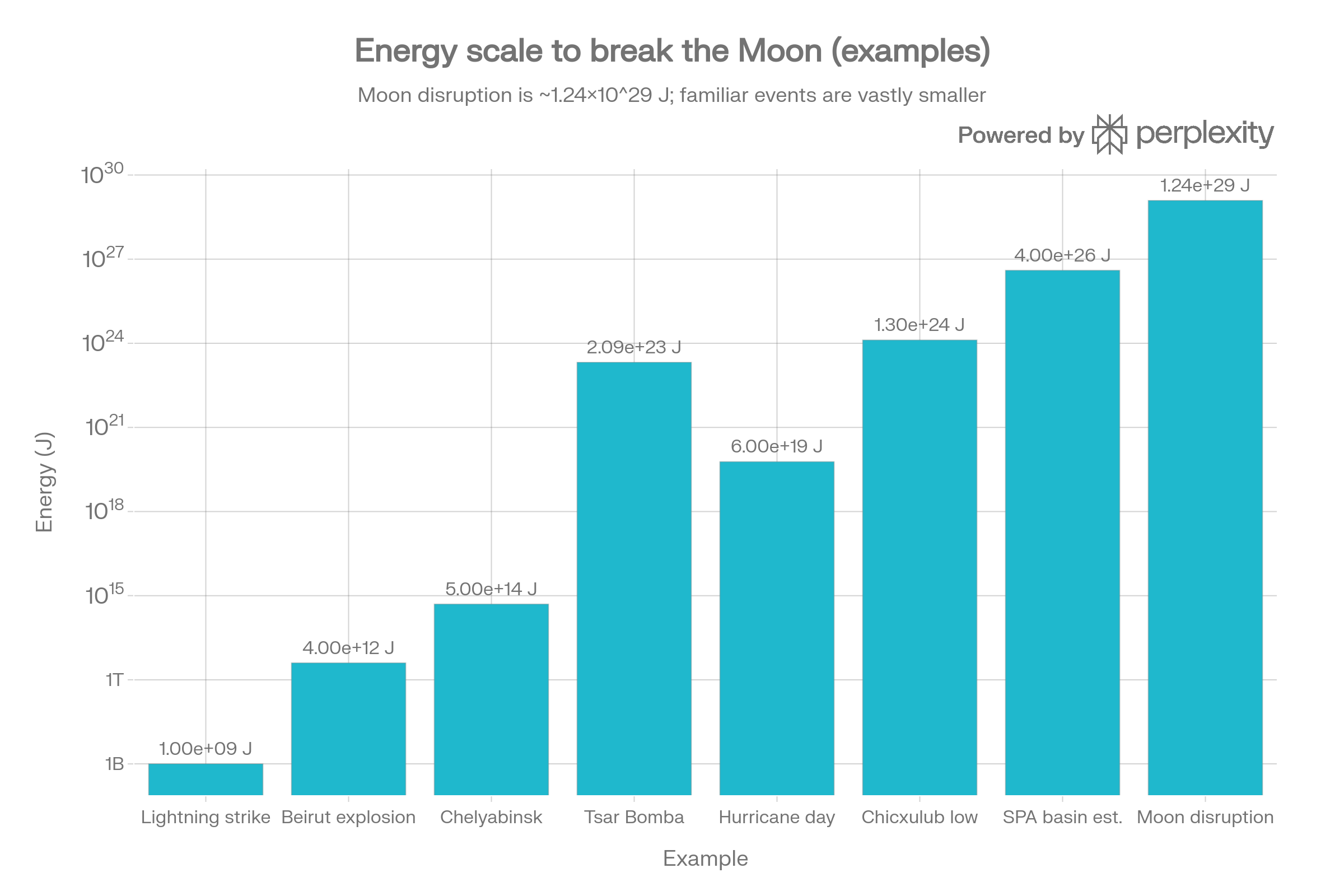
The comparison uses a rough Moon disruption threshold of about 1.24x10^29 J, alongside context points such as Tsar Bomba at about 2.09×10^17 J, a low-end Chicxulub (asteroid impact at the end of the Cretaceous period 66 million years ago) estimate around 1.3×10^24 J, and a South Pole–Aitken basin estimate around 4×10^26 J. That means even the South Pole–Aitken event is still roughly 300 times smaller than the simplest “break up the Moon” energy scale.
Even the largest known lunar basin-forming impact falls far short of the energy needed to tear the Moon apart truly; a Seveneves-style breakup would require an event in a completely different class.
I hope readers find this as interesting as I did and, at the very least, consider picking up the book if hard sci-fi, space, and engineering pique their curiosity, just as they do mine. I also hope that people who have an aversion to AI can see this as an example that it's not all just slop and quick turnaround. Instead of asking interesting questions, it can lead to more fascinating places.