Artificial limbs, human ingenuity, and the sheer effort of getting on with it.
All that you touch
You Change.
All that you Change
Changes you.—Octavia E. Butler, Parable of the Sower
A man has lost his hand. In its place, he wears a blade.
It reads like a video game character introduction. You can picture the survivor: a rough world, an improvised fix, a body adapted to satisfy new demands.
But he wasn’t imagined. Archaeologists found his remains in the Longobard cemetery of Povegliano Veronese in northern Italy, dating to the sixth to eighth centuries. He was an older man, probably in his forties when he died. Years earlier, his right forearm had been cut through, most likely by a single blow. Where his hand should have been, archaeologists found a knife lying across his body. At the end of the stump was a D-shaped buckle with traces of organic material, most likely leather.
I first met him in an ExtinctZoo video, “The Discoveries That Prove Humans Are Absolutely Insane,” in a segment called “The Ancient Terminator.” The narrator called him an ancient cyborg, and the phrase stuck with me.
When I looked for the research behind the story, the video offered no sources. I started digging. As I read, I stopped thinking about his resemblance to fiction and focused on the person behind the prosthesis.
What could he do next?
The phrase “ancient cyborgs” is provocative, but it is closer to the truth than it first appears. Though not in the word's original sense.
When Manfred Clynes and Nathan Kline coined the word "cyborg" in 1960, they defined it strictly: a living body equipped with self-regulating, automatic devices or machines that adjust themselves so the wearer does not have to constantly monitor or control them. In other words, a true cyborg, in their view, merges with machines that work on their own to keep the body alive and functional. They warned that an astronaut who had to keep "checking on things and making adjustments" to stay alive "becomes a slave to the machine." By that standard, no one in this piece qualifies. An iron hand that has to be set with your other hand is the opposite of automatic.
The philosopher Andy Clark presents a broader definition. In Natural-Born Cyborgs, he argues that humans have always been cyborgs because our minds are built to take in tools and make them part of how we act. He puts that kind of merger “on a direct continuum with clothes, cooking, bricklaying, and writing.” That’s the sense I mean. A strap tightened with the teeth or a toe laced to a foot makes body and tool into one working system.
Some of these cases are ancient, others medieval or Renaissance. I use the image for clarity, not as a strict historical category. Cyberpunk has imagined augmented bodies for decades, but these people reached similar solutions first, using wood, leather, bronze, and iron.
What matters is the problem under the surface. Their bodies changed. What did they do next?
It’s tempting to picture these people as simpler versions of us. They weren’t. Our species is about 300,000 years old, and the full range of modern human behavior was in place by 75,000 years ago. Since then, the toolkit has changed, but the intelligence has not. These people worked with fewer materials, less accumulated knowledge, and almost no margin for error. They solved problems anyway.
Imagine waking up each morning and strapping on a wooden toe before taking a step, or tightening a knife-hand device to prepare food or get through the day's work. Something as ordinary as walking across a courtyard or carrying a bucket could demand careful adjustment, patience with discomfort, or on-the-spot repairs. Adaptation was not only about invention but about the repeated, daily challenges of living with new limits and making their solutions work.
One ground rule before going further: these objects are evidence, not diaries. They can show how something was made, worn, and repaired. They can’t tell us how the wearers felt, and I won’t pretend they can.
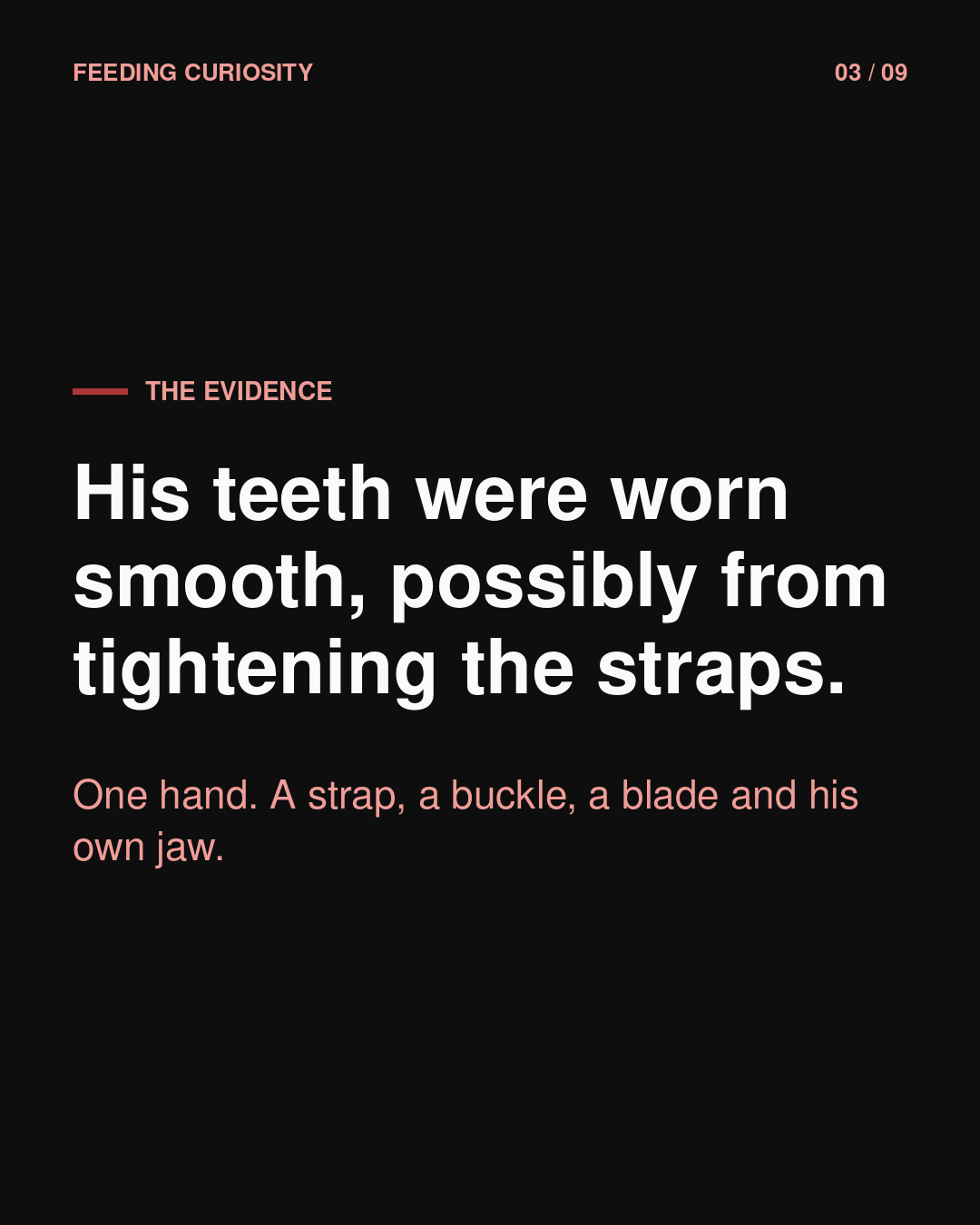
The Italian man’s skeleton gives clues, though not a complete biography. The ends of his forearm bones healed, then reshaped themselves in a way that suggests steady pressure on the stump, consistent with wearing a fitted device. His right shoulder joint had moved slightly, and the upper-arm bone had thinned. One upper incisor was worn unusually smooth. The researchers think he may have used it to tighten the straps.
Picture that last detail as a designer would. He had one hand left, and the fastening needed two. So his teeth became part of the system: a cap, a strap, a buckle, a blade, and his own jaw.
The researchers suggest the prosthesis may have been a cap holding a modified blade, but their firmest conclusion is more modest: he most likely wore something that protected the stump. The device was probably fastened to his forearm with leather straps and a buckle to keep it from slipping during movement. To put it on, he might have slipped the cap over the stump, tightened the straps with his remaining hand and even his teeth, and adjusted it before daily activities. The blade arrangement is a reconstruction, not something that survived intact. He doesn’t need to be a knife-handed warrior to be interesting. He survived an amputation, lived for years afterward, and made strapping on a prosthesis part of his routine.
Engineering an ordinary life
Around three thousand years ago, a woman in Egypt wore an artificial big toe made of wood and leather. She is often identified as Tabaketenmut, probably a priest’s daughter, and she lived sometime between about 950 and 710 BC. The toe was still attached to her right foot when it was found, and the amputation site had healed.
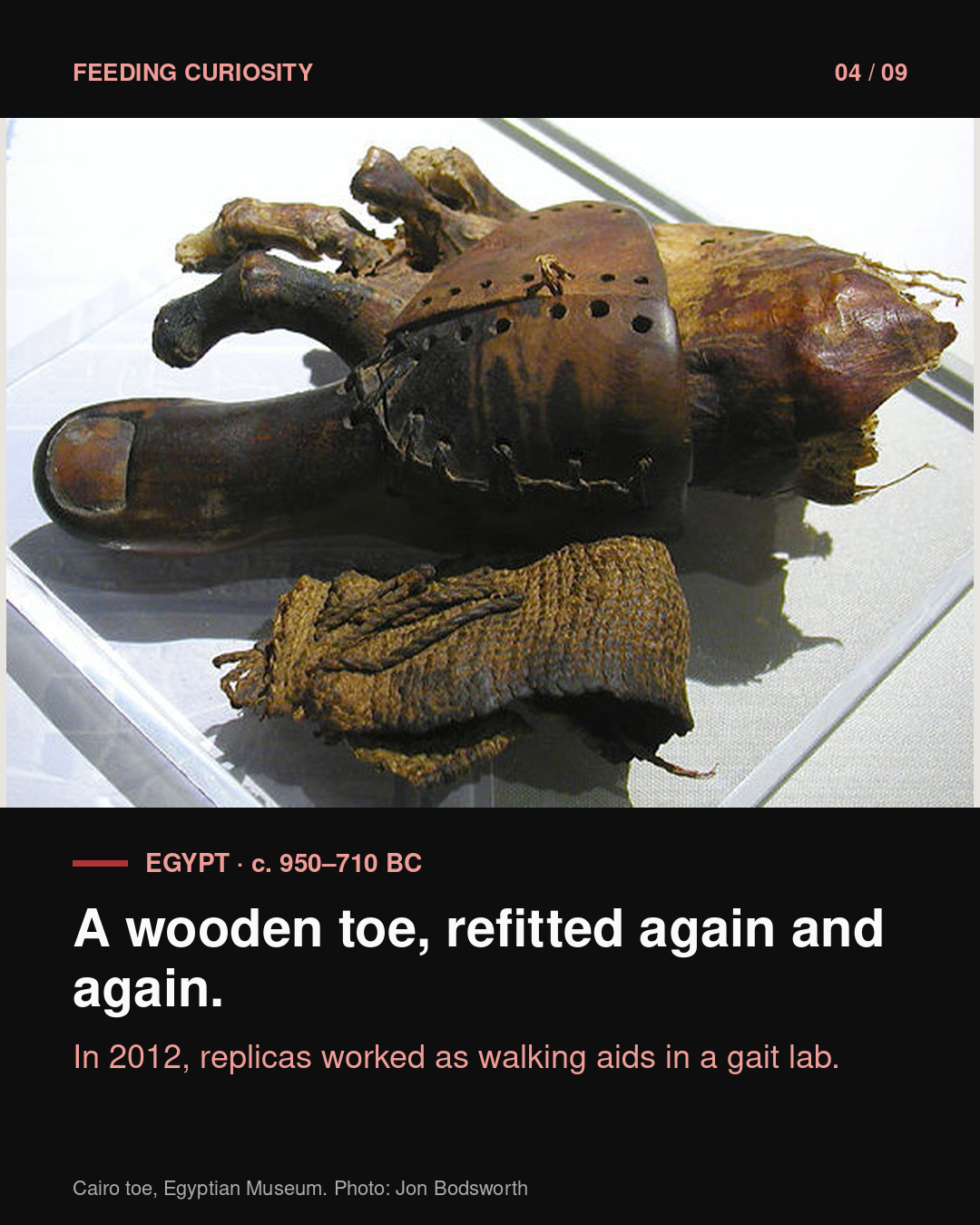
The toe was made of three parts laced together so it could flex with the foot. Its maker used a dense hardwood and beveled the edge where it met the foot. Both choices matter. A big toe can carry up to 40 percent of a person’s body weight in walking, and a hard edge against healed skin would soon become painful.
A later examination led by Egyptologists from the University of Basel found that the toe had been refitted to her foot several times. The full 3D scans had not yet been published when they reported the finding.
We don’t have to guess whether a toe like this worked. In 2012, Jacky Finch and colleagues built replicas of this toe and of a second Egyptian toe now in the British Museum. Two volunteers, each missing their right big toe, wore the replicas in a gait laboratory, both barefoot and in replica Egyptian sandals. Both designs worked as walking aids. The volunteers found the wood-and-leather toe more comfortable than the other.
That matters because ancient Egyptians sometimes added artificial body parts during mummification for religious reasons. Finding one on a mummy doesn’t prove its owner wore it in life. Here, though, the evidence lines up: a healed amputation, wear, repeated refitting, and a replica that works.
A wooden toe is less dramatic than a knife-hand, so it's more instructive. Anyone who has built or repaired something knows the cycle: build, fit, wear, find the problem, adjust, repeat. Did something rub? Was the lacing awkward? Each refitting answered a practical question.
We notice invention when it is dramatic, but it can also be a better fit, a strap that holds, or something comfortable enough to use the next day again. We change something, then learn how living with it changes us. A replacement does not end adaptation. It starts the next round.
Not every replacement was about movement
At Shahr-i Sokhta, a Bronze Age city in what is now southeastern Iran, excavators in 2006 found an artificial eye in the left eye socket of a woman who died around 2800 BC. She was probably between 28 and 30 years old.
According to the excavation report, the eye was a bitumen hemisphere mixed with animal fat. Gold wires finer than half a millimeter trace its blood vessels, and a pupil is drawn at the center. Two small holes, one on each side, likely held it in place. Under a microscope, the object made an imprint in the socket, suggesting she wore it for a long time. Not every archaeologist agrees it was meant to represent an eyeball, though. Some think it was more likely an eyepatch, tied on through the side holes.
Either way, it did not restore her sight. Its purpose was different from a toe or a hand. Still, it was an engineering problem: light enough to wear, secure enough to stay in place, and detailed enough that the gold wire resembled blood vessels.
Adapting to a changed body is not only about mechanical function. Appearance matters, as does being seen by others. We should not assume that something made for appearance was trivial. A life is more than a list of tasks.
The leg that didn’t survive
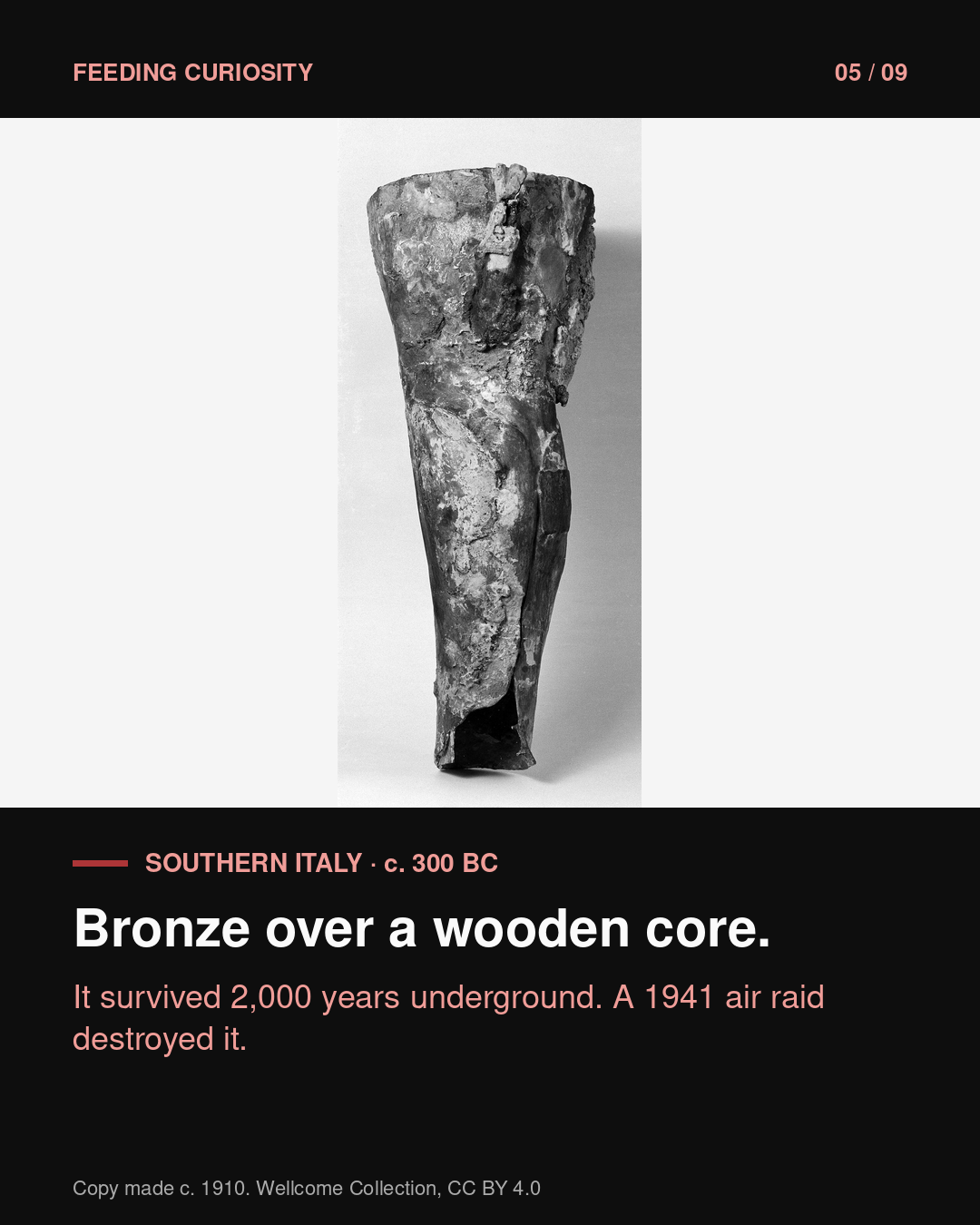
In the winter of 1884–85, excavators near Santa Maria Capua Vetere in southern Italy found an artificial leg beside a man’s skeleton. His lower right leg was missing, and the grave goods dated the burial to around 300 BC. The leg had a wooden core covered in thin bronze, fastened with bronze nails. Iron fittings at the top probably attached it to the thigh. No foot was found. Early descriptions also mention a sheet-bronze belt around the man’s waist, which may have helped hold the leg in place.
The Royal College of Surgeons in London bought the leg in 1886. It was destroyed in a German air raid in 1941. What survives is an imperfect copy made around 1910, along with sketches and written descriptions.
Engineers at Offenburg University in Germany used those records to rebuild the leg as a 3D model. Their conclusion is about as close to this essay’s argument as a sentence can get. The leg shows that its makers “did not create primitive aids, but carefully thought about limbs and developed them on a highly technical level.”
One caution: as of the 2012 replica study, no one had run a gait test on a replica of the Capua leg, so whether it worked well for everyday walking remains an open question.
The leg also shows how fragile the record is. It survived over two thousand years underground, but only a few decades in a museum before it was destroyed. What we can study is not a fair sample of what people built.
A hand made from mechanisms
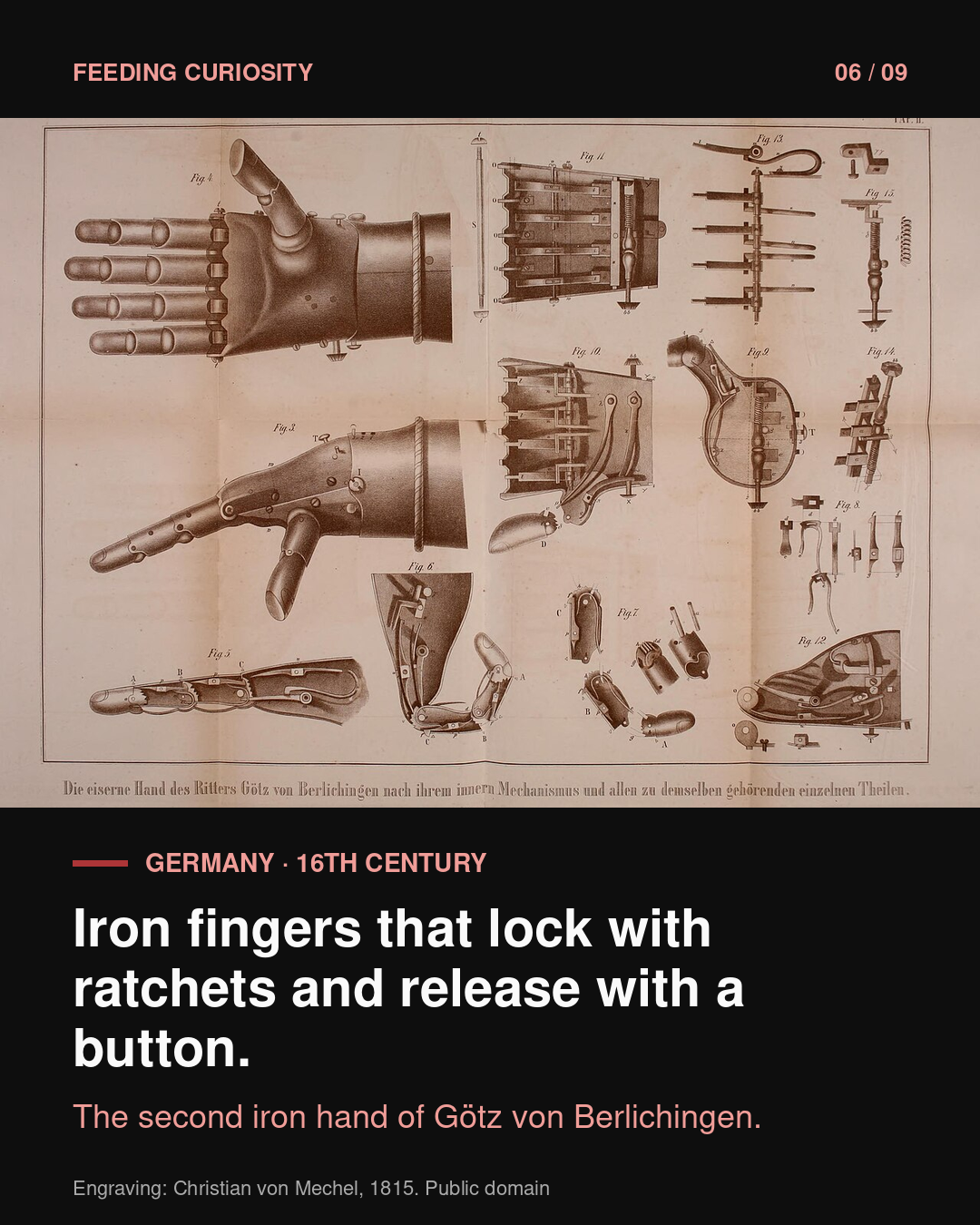
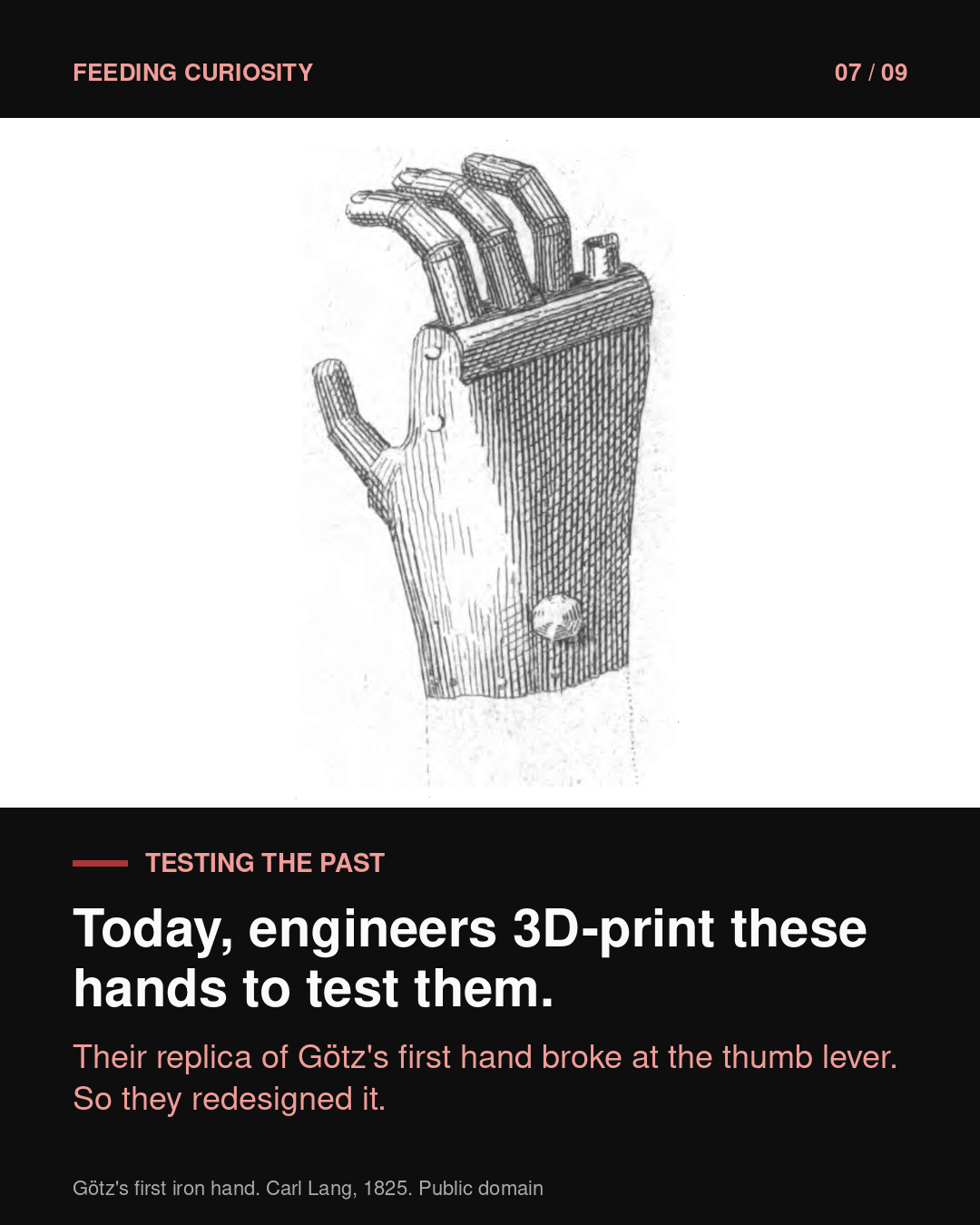
By the sixteenth century, the iron hands of the German knight and mercenary Götz von Berlichingen brought another kind of craftsmanship to the problem. Hinges and locking mechanisms let the fingers be set into a grip and held there. They were passive devices: the wearer’s other hand set them.
Their makers came from a wider world of skilled trades. In early modern Germany, amputees commissioned locksmiths, clockmakers and other artisans to build mechanical hands of iron, brass and wood. Many were set with the other hand and released with a button.
“The street finds its own uses for things.”
—William Gibson, “Burning Chrome”
In the story, Gibson was writing about a drug, not craftspeople. He later expanded the line: the street finds “uses the manufacturers never imagined.” That’s the part that fits here. Knowledge of springs, catches, and locks answered a different question: how might someone hold a cup again?
The wearers weren’t passive, either. Historian Heidi Hausse argues that wealthy amputees directed the artisans who built their hands, molding the work to suit their needs, appearance, and budgets. That runs counter to one of cyberpunk’s favorite images. Deus Ex: Human Revolution gave the genre its most weary line: “I never asked for this,” said a man augmented without his consent. These people did ask, and they told the makers how it should work.
Asking costs money, though. Hausse writes that one seventeenth-century German prosthesis may have cost as much as a large farm, including buildings, fields, and livestock. That was one example, not a standard price, but it makes the limits of access hard to ignore.
Who could afford to commission a hand like this? Who could keep it in repair? What did others do? Most museum objects are iron and belonged to the wealthy. Ordinary people's wooden pegs, leather cups, and improvised solutions rarely survived.
Testing the past
The best way I know to respect an old machine is to try to make it work again.
That is the premise of experimental archaeology, the subject of Sam Kean’s Dinner with King Tut. Instead of only theorizing about objects, people in this field rebuild them and test them. Kean describes our distant ancestors as “every bit as intelligent as we are today, and every bit as prone to folly.”
Kean also tried trepanation, one of the oldest known surgeries, in which a piece of the skull is removed. He practiced on a deer head with stone tools at an experimental-archaeology school in Maine. A fresh obsidian edge was extremely sharp but dulled quickly. After his first clean cut, he said, the rest became “a war of attrition.”
Surgery shows the same learning-by-doing as prosthetics. In a study of more than 800 trepanned skulls from ancient Peru, researchers judged survival by whether the bone had healed around the opening. About 40 percent of patients survived between 400 and 200 BC. By the Inca period, average survival had risen to 75–83 percent, as practitioners learned to make smaller openings and avoid puncturing the membrane around the brain. The authors compare those figures with cranial surgery in the American Civil War, when 46–56 percent of patients died. The comparison is imperfect, because healed bone and hospital records measure different things. Still, it describes a skill that improved over hundreds of years through experience.
Researchers are now applying the same approach to iron hands. Offenburg engineers 3D-printed a replica of Götz’s first hand that could hold a wine glass, a phone, or horse reins. In the first version, the thumb lever broke under heavy stress, so they redesigned it and retested it. Heidelberg researchers have since scanned the specimen with CT to study its mechanism without taking it apart.
Hausse and engineer Chad Rose are doing similar work on the Kassel Hand, a sixteenth-century iron hand whose wearer is unknown. Its fingers lock through toothed wheels, pawls, and springs. When the team built their own model, the pawls slipped under load until they refined the ratchet teeth. Anyone who has built a prototype knows that moment. The hand can’t hold a quill well, but they don’t treat that as a design failure: “More accurately, the artifact is designed to do something else.”
The method has limits. A replica made from modern materials may work better or worse than the first, and a careless experiment can mislead. A working replica shows what a design could do, not exactly how it was used. Still, the method treats the earliest makers as engineers whose work can be tested and can still teach us.
Survival was not an individual achievement

The knife-hand image suggests one man’s determination and self-reconstruction. The researchers who analyzed him emphasized something less cinematic. They wrote that his survival “testifies to community care, family compassion and a high value given to human life.”
That may be the most important detail in the whole account. Surviving an amputation without antibiotics meant stopping the bleeding and keeping the wound clean while it healed. Getting through it was an achievement in its own right, not just a prelude to an unusual replacement.
The same is true of the other objects. Behind each one was a maker whose name we’ll never know, solving a problem with no manual to follow: lacing and refitting a toe, shaping bitumen and gold wire into an eye, riveting bronze over wood, cutting ratchet teeth in iron.
Determination and help from others are not competing explanations. Accepting care and relying on someone else’s skill don’t diminish adaptation. They’re part of it.
Their lives were not preliminary versions of ours
This is not an argument that people in the past were tougher than we are. Pain is not a competition. Suffering is not automatically ennobling. Someone who couldn’t recover from a devastating injury didn’t fail a test of character.
Nor does adaptation have to mean recovering every lost ability. It can mean finding a different method, relying on help, or building a life around a limitation that never goes away. What interests me is adaptation without any expectation of invulnerability: how people keep living with loss rather than defeating it.
It is easy to list what earlier people lacked: antibiotics, steel alloys, CT scanners. It takes more attention to see what they did with what they had. A strap tightened with the teeth. A wooden toe beveled at the edge. Bronze riveted over wood. A ratchet that holds.
Their times were not simpler. Those constraints were tighter. These were not primitive drafts of our solutions. They were solutions, made by people as capable as we are, working on urgent problems with the materials, knowledge, and help available.
The phrase “ancient cyborgs” draws attention. The real question is not how closely these people resemble our imagined future, but what they managed to do with what they had, and who helped them.
Sources and further reading
Framing and quotations
Octavia E. Butler, Parable of the Sower (1993), Chapter 1 epigraph. Extract published by New Scientist.[
ExtinctZoo, “The Discoveries That Prove Humans Are Absolutely Insane”, YouTube (2025). The video where I first encountered the Longobard man.
Clynes, M. E., & Kline, N. S. (1960). “Cyborgs and Space.” Astronautics, September 1960. The paper that coined “cyborg.”
Andy Clark, https://books.google.com/books/about/Natural_Born_Cyborgs.html?id=KAR1a9ziSCsCNatural-Born Cyborgs: Minds, Technologies, and the Future of Human Intelligence (Oxford University Press, 2003). The quotation is from p. 174, as cited in this review.
William Gibson, “Burning Chrome” (Omni, 1982). Background on the story. The expanded wording comes from Gibson’s 1989 essay “Rocket Radio,” collected in Distrust That Particular Flavor (2012). Review quoting the passage.
Deus Ex: Human Revolution (2011), Adam Jensen. IGN developer interview on the line’s meaning.
The Longobard man
Micarelli, I., et al. (2018). “Survival to amputation in pre-antibiotic era: a case study from a Longobard necropolis (6th–8th centuries AD).” Journal of Anthropological Sciences 96.
“This Medieval Man Used a Knife as a Prosthetic Limb,” Smithsonian Magazine (2018).
The Egyptian toe
Finch, J. L., Heath, G. H., David, A. R., & Kulkarni, J. (2012). “Biomechanical Assessment of Two Artificial Big Toe Restorations From Ancient Egypt and Their Significance to the History of Prosthetics.” Journal of Prosthetics and Orthotics 24(4).
“World’s First Prosthetic: Egyptian Mummy’s Fake Toe”, Live Science (2007).
“Egyptian Artificial Toe”, Archaeology Magazine.
“This 3,000-Year-Old Wooden Toe Shows Early Artistry of Prosthetics”, Smithsonian Magazine (2017).
“Mummies’ false toes helped ancient Egyptians walk”, University of Manchester (2012).
The Shahr-i Sokhta eye
Sajjadi, S. M. S., et al. “Excavations at Shahr-i Sokhta (Graveyard 2006–2007).”
“The World in Between”, Archaeology Magazine.
The Capua leg
Otte, A., et al. “Creating a 3-D CAD Reconstruction of the Historical Roman Capua Leg.” PMC.
“Historical Development of Lower-Extremity Prostheses”, Orthopedic & Prosthetic Appliance Journal (1966), via O&P Virtual Library.
Iron hands
Di Matteo, B., et al. (2020). “ArtiFacts: Gottfried ‘Götz’ von Berlichingen—The ‘Iron Hand’ of the Renaissance.” Clinical Orthopedics and Related Research.
Hausse, H. (2023). The Malleable Body: Surgeons, Artisans, and Amputees in Early Modern Germany. Manchester University Press.
Hausse, H. (2025). “The Innovative History of the Artificial Limb Stretches as Far Back as Ancient Egypt.” Smithsonian Magazine.
Review of The Malleable Body, EuropeNow (2024).
Otte, A., et al. (2020). “3D CAD Reconstructions and 3D Multi-Material Polymer Replica Printings of the First ‘Iron Hand’ of Franconian Knight Gottfried (Götz) von Berlichingen: An Overview.” Prosthesis 2(4). Summary including the thumb-lever redesign.
Heidelberg University, “Die ‘Eiserne Hand’ des Götz von Berlichingen im CT” (2026). In German.
Hausse, H., & Rose, C. G. (2026). “3D-Printed Prostheses and Early Modern Iron Hands.” Bulletin of the History of Medicine 100(1). Accepted preprint.
Experimental archaeology and trepanation
Sam Kean, Dinner with King Tut (2025). Introduction and Chapter 1 excerpt.
“Sam Kean Explores the Wild World of Experimental Archaeology”, Scientific American podcast (2025).
Kushner, D. S., Verano, J. W., & Titelbaum, A. R. (2018). “Trepanation Procedures/Outcomes: Comparison of Prehistoric Peru with Other Ancient, Medieval, and American Civil War Cranial Surgery.” World Neurosurgery 114.
“Sam Kean’s new book explores the life of ancient Egyptian kings… by living like one,” NPR (2025).