Range, generative tools, and the case for human–computer symbiosis
Recently, friends less interested in technology told me that AI-generated images and videos take less effort and are therefore worth less.
I understand the criticism, and I worry when people share work without looking closely. I don't want to defend every new tool. But effort alone doesn't determine a work's value.
Making it easier to express an idea doesn't mean there's less thought behind it.
I find myself somewhere between excitement and skepticism. What interests me most isn't simply doing the same work faster; it's using these tools to follow ideas I couldn't reach on my own.
To explain why, I have to go back to something I was thinking about before generative AI was even part of the conversation.
Range was never about knowing a little
In my blueprint for David Epstein's Range, I put words to a feeling I'd had for years: pursuing different interests can make meaningful work possible, not distract from it.
Epstein draws on psychologist Robin Hogarth's distinction between "kind" learning environments, where patterns repeat, and feedback is quick and accurate, and "wicked" ones, where rules are unclear, and feedback is delayed or unreliable. Chess and golf are kind; much of the world is wicked. In those messier fields, a broad range of skills can help.
I never thought specialists were outdated. I argued that we should specialize while staying as curious as we can. What fascinated me was the space between specialties: people who spot connections, translate ideas, and put knowledge to unexpected use. I called them interpreters.
You can understand a problem in one field and notice something valuable in another without being an expert in both. For me, generative tools make it easier to turn that kind of connection into action.
An older vision of computing
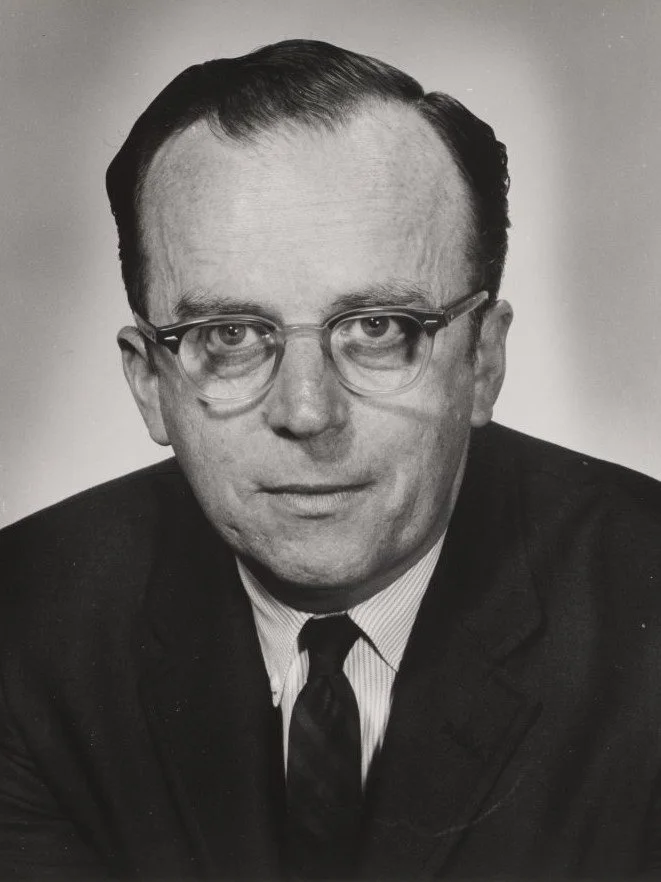
Unknown photographer, ca. 1963, DARPA. Public domain (U.S. Government). Commons
M. Mitchell Waldrop's The Dream Machine introduced me to J. C. R. Licklider's vision of people and computers working together.
Licklider was a psychologist before he was a computing pioneer. His 1960 paper, "Man-Computer Symbiosis," opens with an image from nature rather than engineering:
"The fig tree is pollinated only by the insect Blastophaga grossorun [sic]. The larva of the insect lives in the ovary of the fig tree, and there it gets its food. The tree and the insect are thus heavily interdependent."
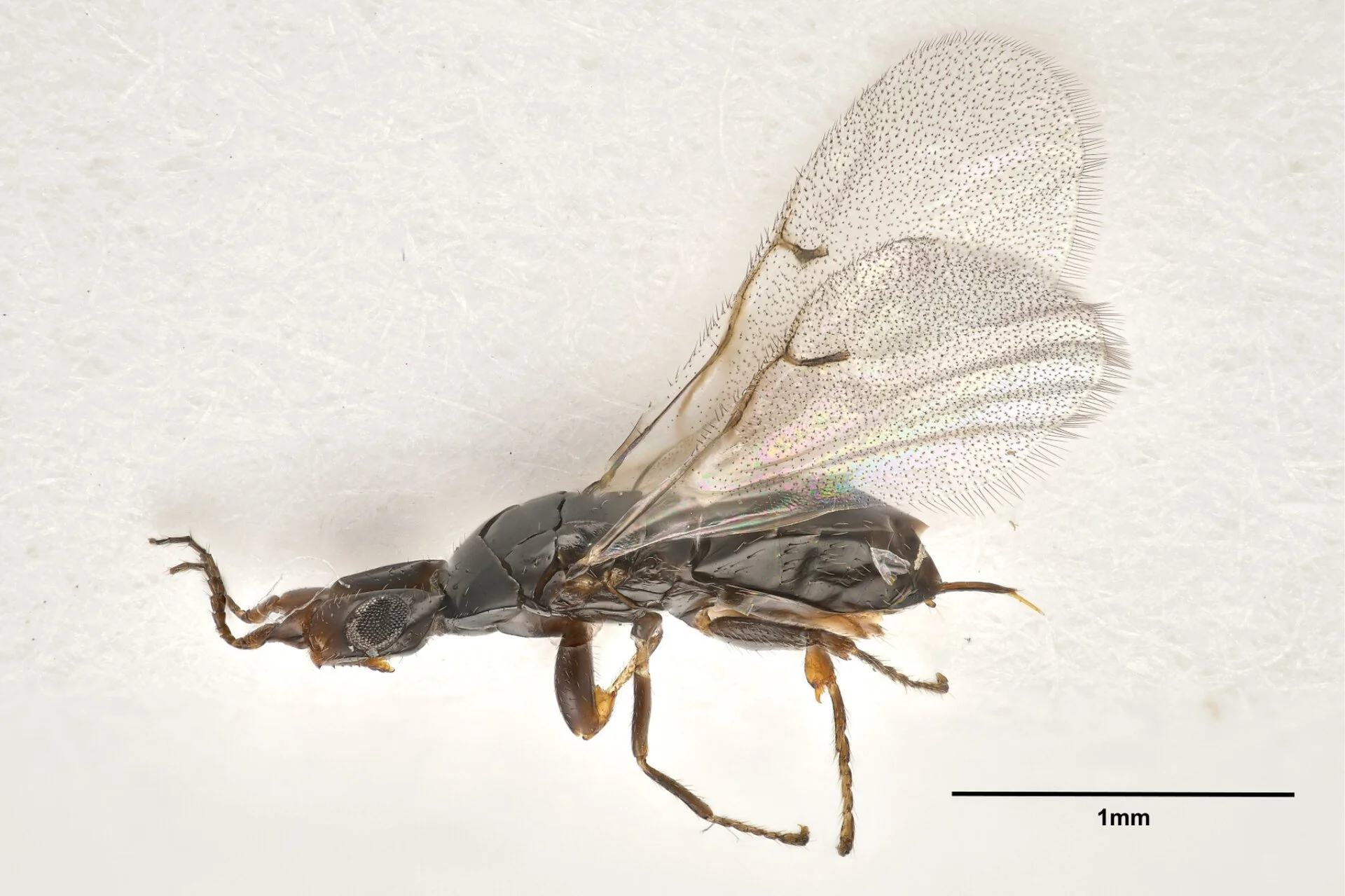
Rehberger S. et al. (2024), CC BY 4.0. Commons
He described what he hoped people and computers could become:
"The hope is that, in not too many years, human brains and computing machines will be coupled together very tightly, and that the resulting partnership will think as no human brain has ever thought and process data in a way not approached by the information-handling machines we know today."
What makes the paper more than just a prediction is how he got there. In 1957, he tracked his own working hours to see where his thinking time really went. The answer unsettled him:
"About 85 per cent of my 'thinking' time was spent getting into a position to think, to make a decision, to learn something I needed to know."
And then the line that stuck with me most:
"My choices of what to attempt and what not to attempt were determined to an embarrassingly great extent by considerations of clerical feasibility, not intellectual capability."
Our ideas are often limited less by imagination than by the time, tools, and training available to us.
Licklider was clear about what each partner would bring. (He wrote in the language of 1960; by "men" he means people.)
"Men will set the goals and supply the motivations, of course, at least in the early years. They will formulate hypotheses. They will ask questions… they will define criteria and serve as evaluators, judging the contributions of the equipment and guiding the general line of thought."
He wanted people to think with computers as they might with colleagues whose skills complement their own.
I don't see this as proof that today's tools have fulfilled his vision. The better question isn't what a machine can do alone, but what the partnership lets us do that we couldn't do before. That distinction matters because better doesn't only mean faster.
Better doesn't only mean faster
Speed is the easiest benefit to picture. But two years after Licklider's paper, when Douglas Engelbart defined what he meant by "augmenting human intellect," speed was only one piece of it:
"More-rapid comprehension, better comprehension, the possibility of gaining a useful degree of comprehension in a situation that previously was too complex, speedier solutions, better solutions, and the possibility of finding solutions to problems that before seemed insoluble."
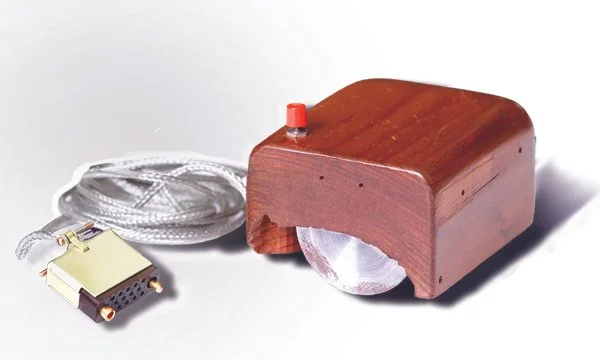
SRI International, CC BY-SA 3.0. Engelbart 1968, first mouse
I experienced this while reading Neal Stephenson's Seveneves. Curious to see the Moon break apart—fragments colliding and splitting—I used a generative tool to build a time-lapse visualization. I'm an engineering technician, not an animator or web developer. At first, I made it simply to satisfy my own curiosity.
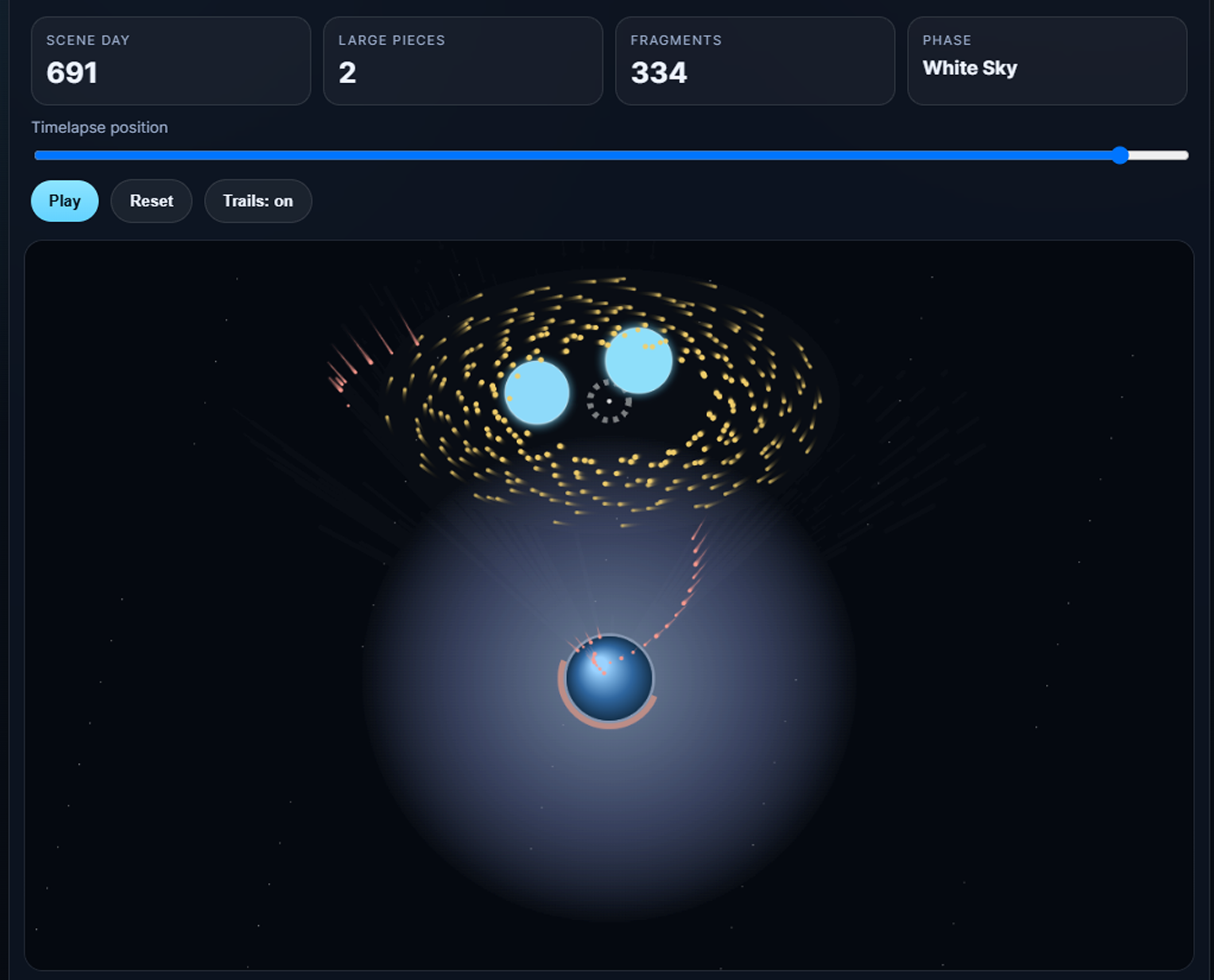
Visualization of the Moon breaking into fragments, from my Seveneves time-lapse
Next, I built a calculator for readers that compares an impact's energy with the energy holding the Moon together. I wanted to bring real science to the science-fiction conversation and show the actual numbers behind the story.
I then learned enough GitHub to put the simulation and calculator online for others to use.
I didn't need to become an animator or web developer. Curiosity was enough to let me explore those fields and make something useful.
Licklider quoted mathematician Henri Poincaré: "The question is not, 'What is the answer?' The question is, 'What is the question?'" That captures how the Moon project changed for me. It began as a visual, then led to a better question: what would help a reader see that breaking up the Moon is more than a plot device?
Knowing what you want is only the beginning
My Moon project began with a clear goal, so at first I imagined this future as outcome-driven: you know what you want, give an agent the materials, and work together to make it happen.
Licklider saw something like this coming. He observed that "instructions directed to computers specify courses; instructions directed to human beings specify goals." People rarely start with a detailed route: "Who, for example, would depart from Boston for Los Angeles with a detailed specification of the route?"
That's close to how we work with agents now. But often I don't know what I want until I begin. A first attempt can show me my idea was wrong, reveal a more interesting direction, or prove that something I thought mattered doesn't.
Licklider valued that kind of discovery too. He described an "intuitively guided trial-and-error procedure in which the computer cooperated, turning up flaws in the reasoning or revealing unexpected turns in the solution."
In my Range blueprint, I argued for playful experimentation and unexpected approaches. I don't want to lose that by requiring a perfectly defined goal for every interaction.
"Help me make this" is one request.
"Help me figure out what I'm missing" is another.
Where Licklider's vision stops
So far, Licklider's vision can sound as if it has arrived. But he was outlining a research agenda for a future that hadn't yet happened. I now work with systems that can run without constant human attention, which raises a harder question: what does that mean for the partnership?
He saw some of this coming. He warned that in some areas, "'mechanical extension' has given way to replacement of men, to automation, and the men who remain are there more to help than to be helped." He also didn't say symbiosis was the final answer. He admitted that machines might one day surpass the human brain at most things we think are uniquely ours. For him, symbiosis was a temporary stage, but an important one: "The 15 may be 10 or 500, but those years should be intellectually the most creative and exciting in the history of mankind."
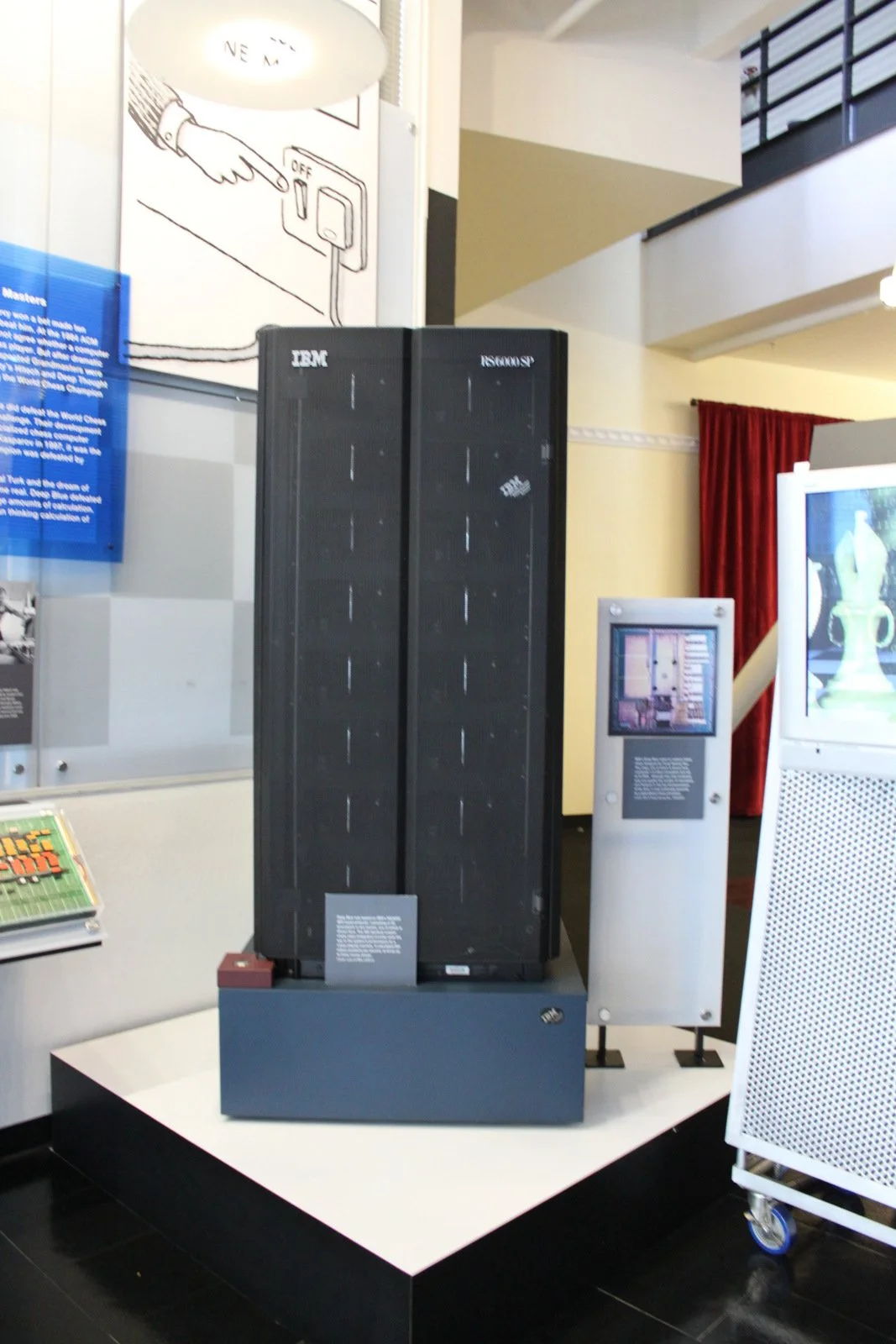
Anton Chiang, CC BY 2.0. Commons
Chess shows what that in-between period can look like, and how it might eventually end.
After Garry Kasparov lost to IBM's Deep Blue in 1997, he began promoting "Advanced Chess," where humans and computers teamed up. In 2005, an online "freestyle" tournament allowed anyone to enter: players, computers, or any mix. The winners weren't grandmasters with the best machines, but two amateur American players working with three regular computers. Kasparov later summed it up:
"Weak human + machine + better process was superior to a strong computer alone and, more remarkably, superior to a strong human + machine + inferior process."
Epstein tells this story in the first chapter of Range, seeing the winning team as the best at coaching several computers and weaving their advice into a strategy. What stood out to me was his description of "humans empowered to do what they do best without the prerequisite of years of specialized pattern recognition." This feels like the closest example I've come across of the interpreter role I keep circling back to.
Epstein also notes that newer engines may beat even the best human-computer teams. In correspondence chess, where engines are allowed, 80 to 90 percent of top games end in draws. Human judgment still matters to strong players, but its space may be shrinking. How long will it last?
Range offers another perspective. Chess is a classic kind learning environment, with clear rules, quick feedback, and precise judgments. If machines can replace people anywhere, it may be here. I'm more interested in messier work: explaining ideas, designing for others, and deciding what should exist. Human-machine partnerships may last longer there because success is harder to define. In the end, our roles may depend on what kinds of work we value.
Competition seems to be something we seek out, judging by all the rules we invent for sports. Anti-doping programs exist so that no one has an advantage beyond what they were born with and what the sport allows. But what happens when a machine enters the race? In 2025, Beijing hosted a half marathon where humanoid robots ran alongside about 12,000 people. The robots had to run on two legs, kept to their own fenced-off lane (TechCrunch), and the winner needed three battery changes to finish in 2 hours 40 minutes, more than twice the time of the fastest human (Reuters). The organizers wrote rules to make the robots look more like us, but still kept them separate. Maybe that's the answer. A human racing a machine isn't all that interesting, either because we assume the machine will win eventually or because our limits are too different to compare. What draws us in is watching people push against limits we all share.
That doesn't make machine-made work less valuable. But as generated content grows, we may value experiences machines can't replicate, like live performances and being together in one place. Even putting phones away can make an event feel more present.
What the evidence shows
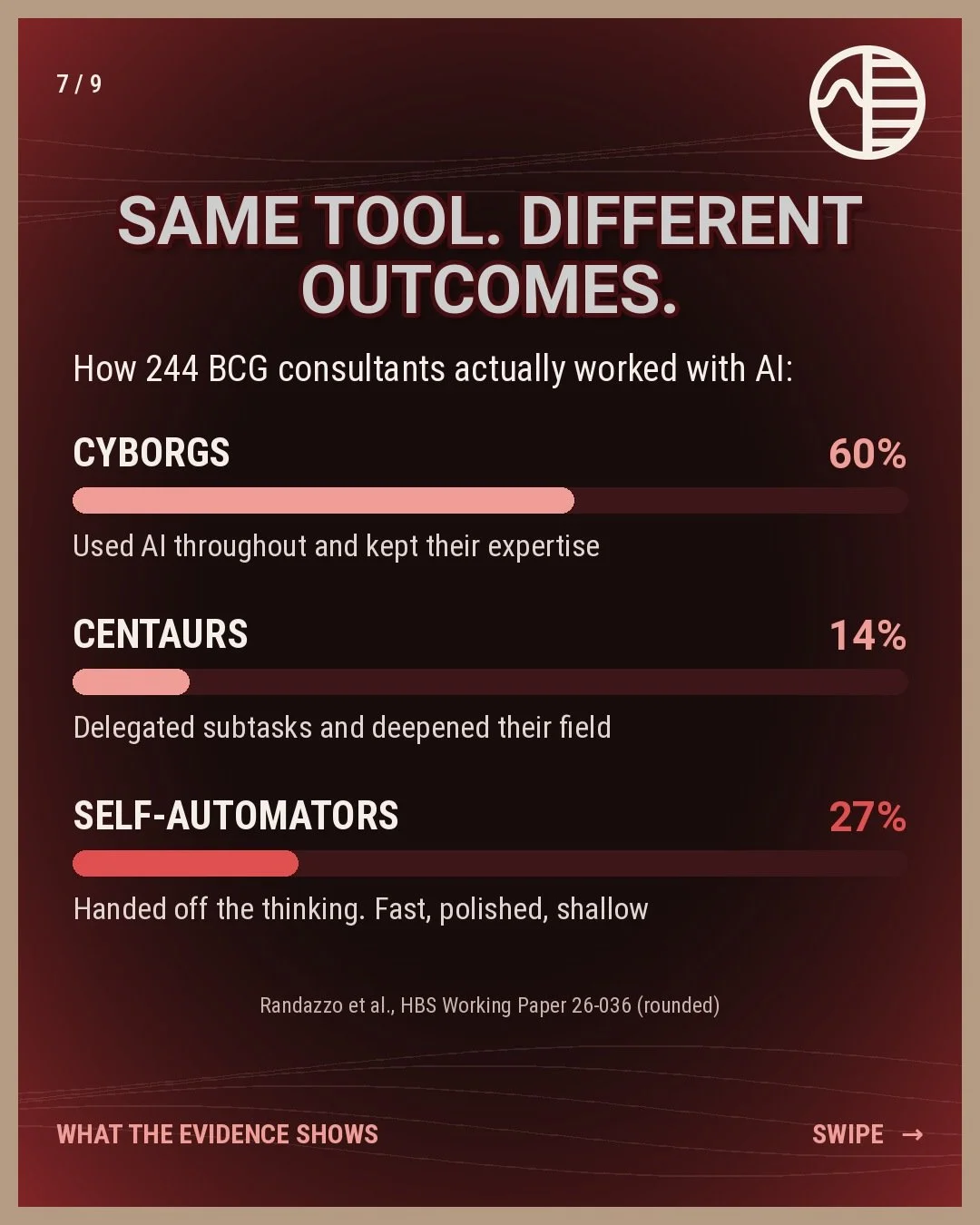
Data: Randazzo et al., HBS Working Paper 26-036
Licklider's idea persisted, even as computing split into two approaches. Shan Carter and Michael Nielsen describe augmentation research as building systems that put people and machines to work together, while AI has focused on outsourcing intellectual tasks to machines. Now we have evidence about what happens when those approaches meet, and the results are mixed.
In a big experiment with Boston Consulting Group, consultants who used AI for tasks it could handle did more work, finished about 25 percent faster, and produced work rated about 30 percent higher in quality. The researchers called the uneven line of what AI does well a "jagged frontier." On a task picked to be outside that frontier, consultants using AI were 19 percentage points less likely to get the right answer than those working alone.
A follow-up study of 244 BCG consultants examined how they actually worked with AI, identifying three patterns (percentages rounded):
Cyborgs (60%) used AI throughout their work. They learned new AI skills while keeping their consulting expertise.
Centaurs (14%) used AI for certain subtasks but kept control of the overall analysis. They deepened their expertise in their field.
Self-Automators (27%) handed off "both analytical and evaluative thinking to the system." Their work was "fast and polished but lacked depth, resembling outputs completed for them rather than with them."
Self-automators concern me most. They gained neither deeper expertise nor new AI skills, and almost half accepted the system's output unchanged.
A symbiosis you can touch
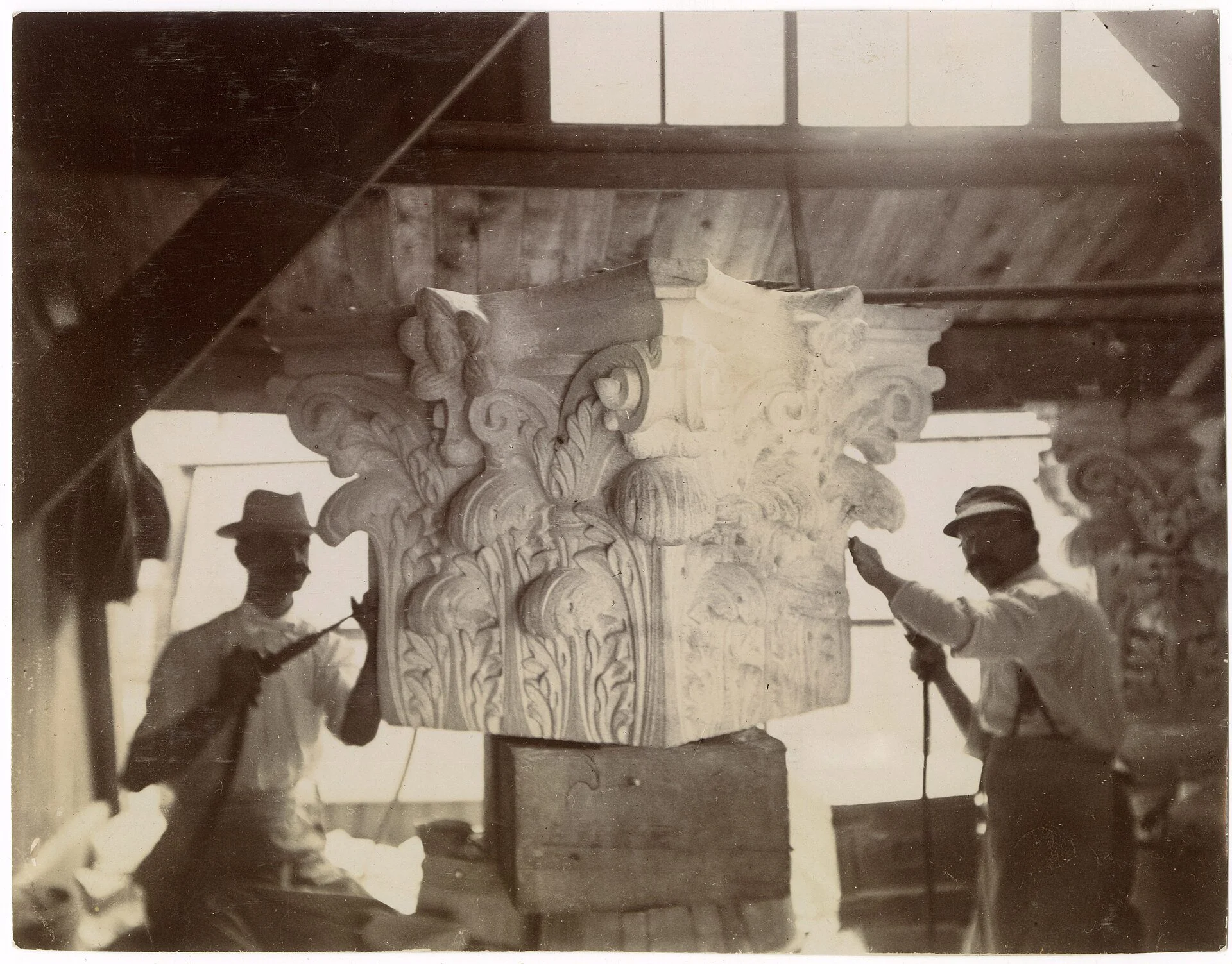
Unknown photographer, early 1900s. Public domain. Commons
This kind of partnership isn't limited to screens. At New York's Monumental Labs, stone sculpture and architecture are "milled by robots, finished by hand." Digital artists turn drawings, scans, or rough ideas into 3D models; seven-axis robotic arms carve the stone, and sculptors finish each piece by hand.
If you walk through an older city, you can see how much carved ornament used to shape our buildings: capitals, balconies, faces looking down from the stone. Most of this disappeared from new buildings in the twentieth century. In "The Beauty of Concrete," Samuel Hughes calls this mostly "a story of cultural choice, not of technological destiny." When he visited Monumental Labs, he saw a robot that works two to four times faster than a carver and is "capable of executing about 95 percent of the carving process."
Some of the company's most interesting work is restoration. On Manhattan's landmarked Villard Houses, sandstone balconies had been worn down by 140 years of weather. Many originals were too damaged to copy, so the team looked at old photos and the building's other decorations to make their "best guess of how the panels may have looked."
That "best guess" is where I see Licklider's vision: the robot carves accurately, but people study the remaining clues, imagine what's missing, and judge the result. The machine handles the heavy work and could even run unattended, as long as safeguards let people step in if something goes wrong.
Founder Micah Springut told Architectural Record that a Corinthian capital costing $90,000 by hand costs the company about $30,000, freeing carvers to focus on finishing. Yet programmers still plan the robots' tool paths by hand, a bottleneck the company is increasingly automating. Here, technology enhances one job while automating part of another.
I find hope in a third option between costly, one-off ornament and the plain, mass-produced shapes common in new buildings.
What happens to understanding?
The Monumental Labs example also sharpens a question behind my optimism: does seeing a result mean we understand how it was made? In my blueprint's discussion of learning, I asked whether someone can truly understand what they've seen. That question is harder to avoid now that convincing results are easier to produce.
In a survey of 319 knowledge workers, Microsoft researchers found that confidence in generative AI correlated with less critical thinking, while confidence in oneself correlated with more. They also found that AI shifts critical thinking toward "information verification, response integration, and task stewardship."
This kind of stewardship echoes Licklider's idea of people as evaluators and the Monumental Labs restoration. It also reveals a risk: the more capable a system seems, the easier it is to stop checking its work.
If a tool helps me build something, can I explain why it works, recognize its limits, and tell an unfamiliar solution from a convincing mistake?
I don't think just "learning prompting" is enough. The kind of understanding I care about means being able to:
Explain the problem and why it matters.
Recognize the constraints that matter.
Question assumptions, including my own.
Test the result against something beyond how it looks.
Notice when I need someone with deeper expertise.
Breadth keeps me curious, especially in unfamiliar areas. Test engineering has taught me to check what is happening rather than trust my first assumption. When all four brake-system lights came on recently, my car still drove normally. A bad wheel bearing had sent metal shavings into the ABS sensor, triggering the warning. It reminded me to check the evidence, not just react to appearances.
Slop isn't the future I'm arguing for
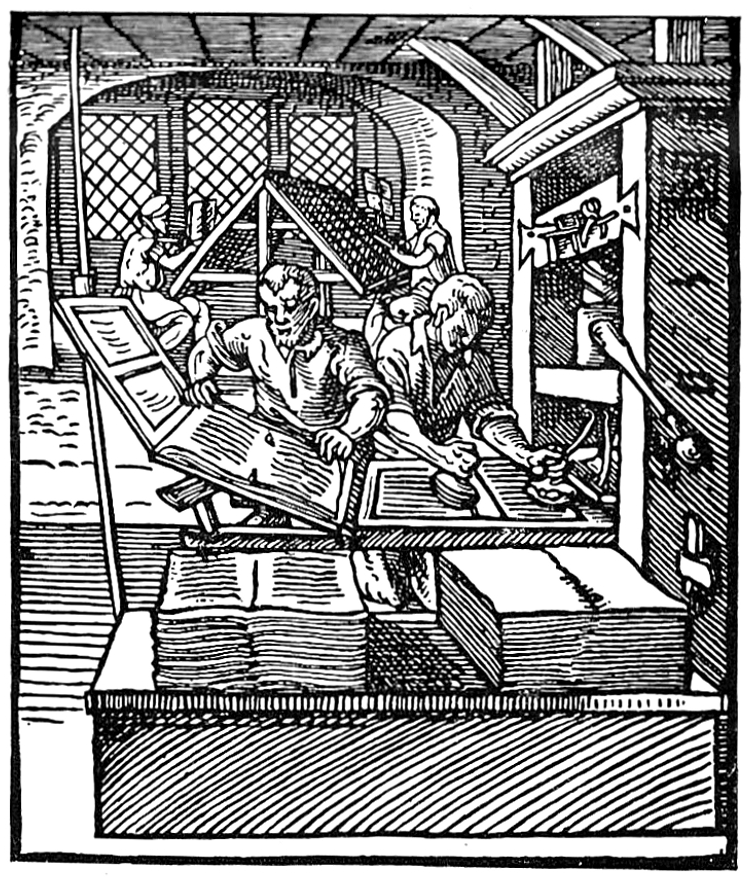
Jost Amman, "Der Buchdrucker," 1568. Public domain. Commons
When I say "slop," I mean work where finishing quickly matters more than caring about the result. It's like what the follow-up BCG study called self-automation: work that's fast and looks fine at first but lacks depth.
This concern isn't new. Around 1473, the Venetian friar Filippo de Strata called the printing press a "whore" compared to the "virgin" pen. Historian Alexander Lee says de Strata complained that printed books were often "festooned with errors," and that printers cared more about releasing new editions than about quality. Lee notes that de Strata had a point: printers did produce many faulty editions (Engelsberg Ideas).
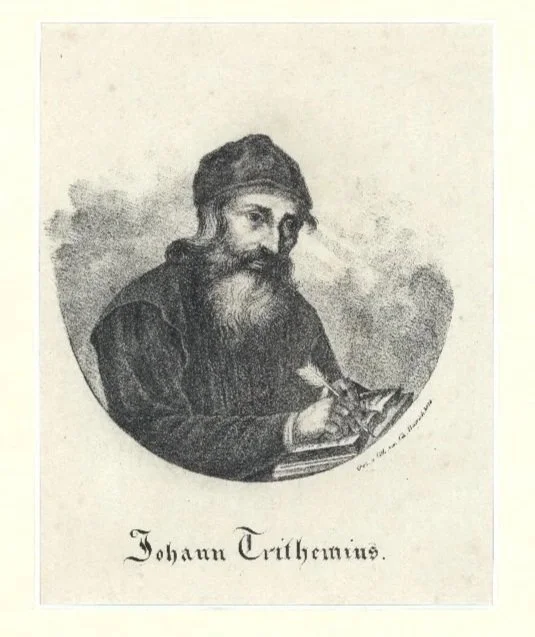
Unknown artist. Public domain. Commons
In 1492, abbot Johannes Trithemius argued for hand-copying books as a spiritual practice. He wasn't against printing; he wanted monks to preserve the craft even as presses changed the world. He had his own work printed and later praised the technology: "O blessed art of printing, long to be remembered as belonging to our age!"
I relate to Trithemius. The craft matters, and I wonder what we lose when we adopt new tools without reflection. I want to make experimentation and sharing easier without giving up responsibility for what we create. Expression isn't the same as understanding; sometimes, meaning comes from slowing down and attending to the process.
A tool, a choice, and governance
On jobs and technology, Erik Brynjolfsson's "The Turing Trap" distinguishes AI that lets people do what they couldn't before from AI that automates existing work, which can cost workers economic and political power. But the line isn't simple: economists Ajay Agrawal, Joshua Gans, and Avi Goldfarb argue that automating part of a job can also create new possibilities. What looks like automation from one angle may be augmentation from another, which is the tension I see in the stone workshop.
As Daron Acemoglu and Simon Johnson argue in Power and Progress, technology's effects depend on how we choose to build and use it. Hughes makes a similar point about ornament: "it was within our collective power to choose differently. It still is." But, as Daniel Sarewitz reminds us in his review of their book, we also have to ask what we mean by "choice."
I'm not calling for a total ban. Trying to control technology too tightly can push people to work around the rules or elsewhere. But some boundaries are necessary. Then the question is who decides what gets built, where limits are set, and who takes responsibility when things go wrong.
Licklider offers a starting point for judging the tools themselves: does this relationship help people think more deeply, question assumptions, and solve problems better, or does it simply produce more output? The question of who decides is the one he left for us.
The interpreters we'll need
When I finished my Range blueprint, I believed we'd always need interpreters: people who bridge specialties and make knowledge accessible. I still do. What's changing is how far they can take a connection once they see it.
I don't know how this will turn out, but I'd rather help shape it than wait and see. The future I hope for isn't one where machines replace curiosity, but one where they help us turn it into something real.
Sources
Feeding Curiosity. "Blueprint: Range." feedingcuriosity.net/blueprint-range
Feeding Curiosity. "Seveneves Moon Explosion." feedingcuriosity.net/blog/seveneves-moon-explosion
Epstein, David. Range: Why Generalists Triumph in a Specialized World. Riverhead Books, 2019. davidepstein.com/range
Waldrop, M. Mitchell. The Dream Machine: J.C.R. Licklider and the Revolution That Made Computing Personal. Viking, 2001; Stripe Press, 2018. ACM Digital Library
Licklider, J. C. R. "Man-Computer Symbiosis." IRE Transactions on Human Factors in Electronics, HFE-1, pp. 4–11, March 1960. MIT CSAIL full text
Engelbart, Douglas C. "Augmenting Human Intellect: A Conceptual Framework." SRI, 1962. Doug Engelbart Institute
Kasparov, Garry. "The Chess Master and the Computer." The New York Review of Books, February 11, 2010. nybooks.com
"Correspondence Chess – The Draw Problem." ChessBase. en.chessbase.com
"Robots Run a Half-Marathon, Slowly." TechCrunch, April 19, 2025. techcrunch.com
"China Pits Humanoid Robots Against Humans in Half-Marathon." Reuters, April 19, 2025. reuters.com
Carter, Shan, and Michael Nielsen. "Using Artificial Intelligence to Augment Human Intelligence." Distill, 2017. distill.pub
Dell'Acqua, Fabrizio, et al. "Navigating the Jagged Technological Frontier: Field Experimental Evidence of the Effects of Artificial Intelligence on Knowledge Worker Productivity and Quality." Organization Science 37(2): 403–423, 2026. doi:10.1287/orsc.2025.21838. HBS PDF
Randazzo, Steven, et al. "Cyborgs, Centaurs and Self-Automators: The Three Modes of Human-GenAI Knowledge Work and Their Implications for Skilling and the Future of Expertise." HBS Working Paper 26-036, December 2025. HBS PDF
Monumental Labs. Homepage, "Sculpture," "Architecture," and "About." monumentallabs.co
Hughes, Samuel. "The Beauty of Concrete." Works in Progress, May 17, 2024. worksinprogress.co
"Monumental Labs Turns to Automation and Robots to Revive the Art of Stone Carving." Architectural Record, February 9, 2026. architecturalrecord.com
Lee, Hao-Ping (Hank), et al. "The Impact of Generative AI on Critical Thinking: Self-Reported Reductions in Cognitive Effort and Confidence Effects From a Survey of Knowledge Workers." CHI '25. Microsoft Research PDF
Lee, Alexander. "The War Against Printing." Engelsberg Ideas, August 1, 2022. engelsbergideas.com
"Who Created the New and Copied the Old." Wertheimer exhibition catalog, Haverford College Library. haverford.edu PDF
Brynjolfsson, Erik. "The Turing Trap: The Promise & Peril of Human-Like Artificial Intelligence." Dædalus, Spring 2022. Stanford Digital Economy Lab PDF
Agrawal, Ajay, Joshua S. Gans, and Avi Goldfarb. "The Turing Transformation." Brookings, June 2023. brookings.edu
Acemoglu, Daron, and Simon Johnson. Power and Progress: Our Thousand-Year Struggle Over Technology and Prosperity. PublicAffairs, 2023. MIT Shaping the Future of Work
Sarewitz, Daniel. "Economists Being Economists." Issues in Science and Technology 40(2), Winter 2024. issues.org