Subscribe on your favorite platform: Apple Podcasts | Spotify | YouTube
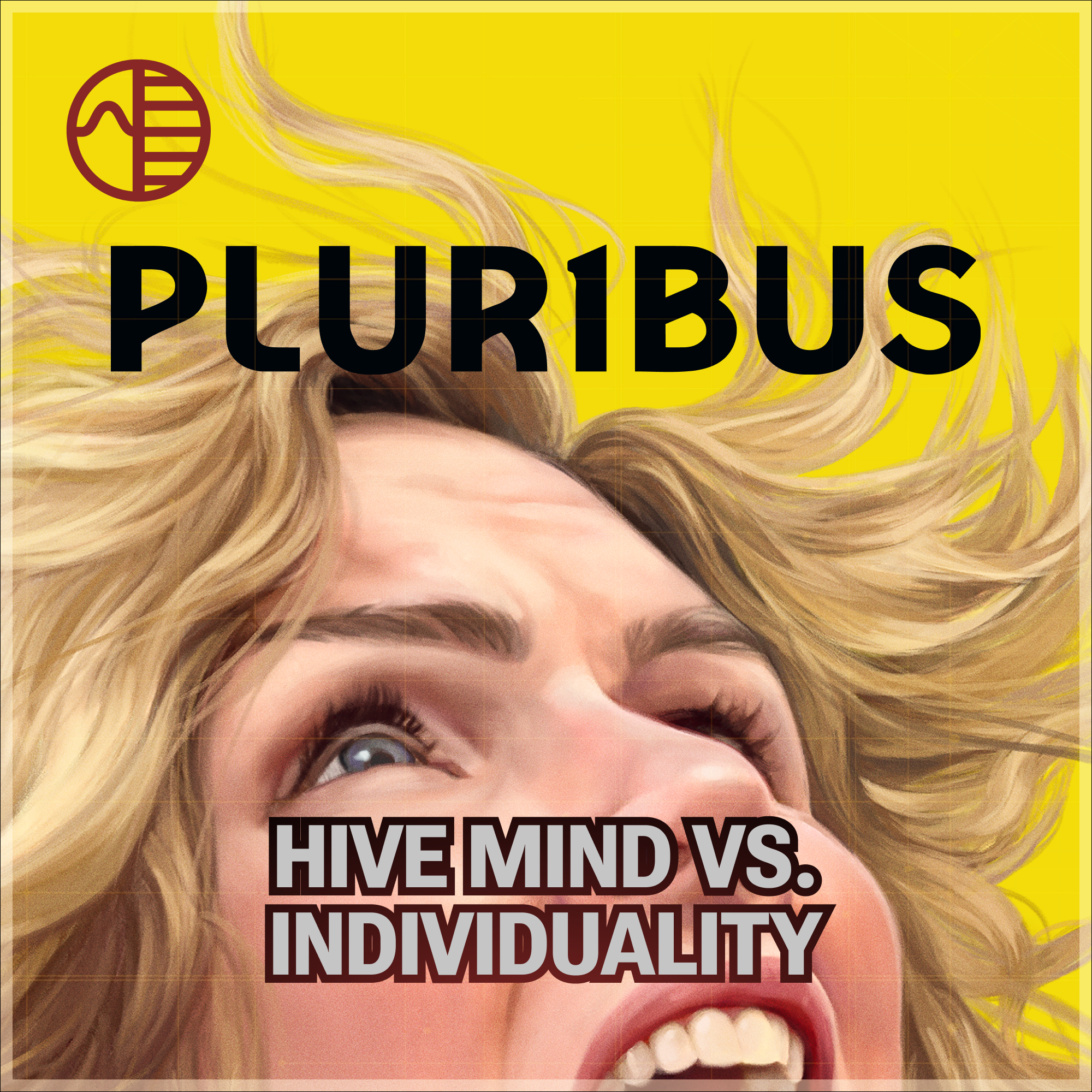
Today on the podcast, we dive into the intricate world of "Pluribus" – a show that has captured our fascination with its unique blend of science fiction and philosophical exploration. As fans of deep, thought-provoking narratives, we dissect the layers within "Pluribus" to uncover the underlying messages it conveys about individuality, unity, and the human condition.
At the heart of our discussion is the show's protagonist, Carol, a successful yet disillusioned romance writer whose personal conflict mirrors a larger, universal theme. As we explore Carol's journey, portrayed with varying degrees of success in the show, we see her struggle against a hive mind that embodies a false sense of happiness and unity. This struggle raises powerful questions: Does collective happiness justify the erasure of individuality? And what happens when individuality meets the pressure of conformity?
Establishing the World
As we enter the world of "Pluribus," the show methodically builds a setup in which humanity is infected by a mysterious alien signal that turns them into a hive mind. From the seemingly mundane to the extraordinary, the transition is cleverly depicted. Erich and Joe note the show's pacing, likening it to a slow burn that grows increasingly unsettling as the narrative unfolds. This intentional slow development is reminiscent of the structure seen in "Breaking Bad," wherein narrative depth is achieved through a binge-worthy format.
The Characters and Their Struggles
Throughout our discussion, we delve into the intricacies of character behavior and development. Carol's initial bitterness towards her life's work and her unwelcoming stance towards this newfound unity catch our attention. Her immunity to the infection adds a layer of complexity, suggesting themes of resistance and self-discovery. Meanwhile, secondary characters, such as the Peruvian recluse, offer counterpoints that highlight different responses to this invasive, unified consciousness.
Philosophical Undertones
Philosophically, "Pluribus" is rich with themes of oneness versus unity, real happiness versus false happiness, and individual versus collective identity. We explore these themes in the context of thought experiments such as Robert Nozick's Experience Machine and the utility monster argument. These concepts elegantly frame the hive mind's portrayal as a limited utopia – one that is inherently flawed due to its refusal to acknowledge individuality and its inability to cope with dissent or negative emotion.
Production and Execution
While breaking down the show's narrative, Erich commends its meticulous cinematography and direction, which elevate its storytelling. However, we also critique certain elements, such as the occasionally inconsistent acting that can detract from the immersion the creators strive for. Our conversation touches on how these aspects potentially impact the pacing and overall execution of the story.
Looking Forward
As we anticipate the next season, we're left pondering some unresolved questions and clues the show deliberately drops, hinting at future developments. Will Carol's battle against the hive mind escalate to her ultimate triumph over homogenized happiness? Can we expect her journey to highlight the eternal struggle between personal freedom and the seductive allure of collective peace?
In closing, "Pluribus" serves as a reflective space to consider our own values amidst a rapidly conforming world. It’s not just a sci-fi series – it's an invitation to question the very fabric of unity and individuality in our society. A must-watch for anyone intrigued by the consequences of conformity and the power of maintaining one's sense of self amidst overwhelming uniformity.
Join us on our blog and podcast as we continue to peel back the layers of more such compelling narratives. Stay tuned for more explorations into shows that challenge the status quo and explore the nuanced dynamics of human existence.
Reference List
Books
Anarchy, State, and Utopia by Robert Nozick (1974)
The Origins and History of Consciousness by Erich Neumann
Silo book series by Hugh Howey
Important People
Vince Gilligan — creator/director of Pluribus, also created Breaking Bad
Robert Nozick — philosopher, discussed for thought experiments
Erich Neumann — Jungian analyst, referenced for the Origins and History of Consciousness
Peter Singer — philosopher, referenced for effective altruism
Theories & Concepts
Experience Machine (Nozick) — would you plug into a simulation of perfect happiness?
Utility Monster (Nozick) — Does collective happiness justify erasing individuals?
Utilitarianism — a moral framework maximizing collective happiness
Hive Mind — collective consciousness trope
Theory of Mind — ability to attribute different mental states to oneself and others
Effective Altruism — Peter Singer's argument for impartial moral concern
Ouroboros — Neumann's symbol of non-distinction and pre-conscious unity
Privacy — a philosophical concept discussed in relation to individuality
Movies / Films & TV
Pluribus (Apple TV+) — the show being discussed
Breaking Bad — referenced for slow-burn storytelling
The Matrix — compared to Nozick's Experience Machine
Silo (Apple TV+) — another Apple TV sci-fi series
Cyberpunk: Edgerunners — mentioned for its Polish writer and depressing tone
Fallout — referenced as a comparison to Silo
5. Scientific Concepts
Brain in a Vat — epistemological thought experiment linked to the Experience Machine
DNA Sequencing — the alien signal in Pluribus is decoded as a DNA sequence
Morse Code — the signal is initially misidentified as this
Observer Effect — discussed re: behavior changing when watched
Bacteria / Microbiology — the alien organism is cultured as bacteria
6. Studies
Big Five Personality Traits — referenced re: agreeableness and behavior in public vs. private
Agreeableness — higher agreeableness is linked to singing in private
Lying and Theory of Mind in Children — higher-IQ children lie at younger ages
Show Notes:
00:00 What Is Pluribus
00:35 Slow Burn Setup
02:10 Meet Carol The Bitter Writer
03:44 Signals To Hive Mind
04:25 Hospital Reveal Scene
05:03 Theme Mass Vs Self
08:20 False Unity Explained
09:19 Craft Cinematography Cast
10:50 Nozick Thought Experiments
13:35 Limits Seizures And Death
16:54 Oneness Politics And Oma
20:30 Manipulation Lying Consent
25:23 Immune Survivors Reactions
26:31 Carol Tries The Utopia
26:54 Hive Mind vs Privacy
28:13 Why Privacy Matters
28:52 Observer Effect and Personality
31:01 Teaching the Hive to Say I
33:38 Oneness Unity and Consent
35:15 Assimilation Without Compassion
35:49 What Love Really Is
39:52 Limits of Altruism and Utopia
42:13 Nuclear Option Finale
45:32 Season Two Breadcrumbs
45:58 What Worked in the Show
47:32 Critiques Acting and Pacing
50:12 Apple TV and Silo Tangent
52:42 Wrap Up and Goodbye